Example numbers are filled in. Change them to yours.
How to count your long-drive bookings
- Pull up last week's schedule and go day by day, one truck at a time.
- Mark each booking where the tech drove across town and a nearer time or a nearer tech was open that day.
- Estimate the extra minutes each one added: the drive there and on to the next stop, minus what the nearer option would have taken. Drive times from a map app are fine.
- Divide the marked bookings by trucks and days to get a per-truck, per-day number.
How it's calculated
Extra minutes a week = trucks × working days × long-drive bookings per truck per day × extra minutes each.
Truck-hours a week = those minutes ÷ 60. Dollars a week = truck-hours × what an hour is worth. A year = a week × working weeks.
It doesn't count fuel or wear unless you add them to the hourly value, and it doesn't count lost jobs, overtime or late arrivals.
Ways to bring the number down
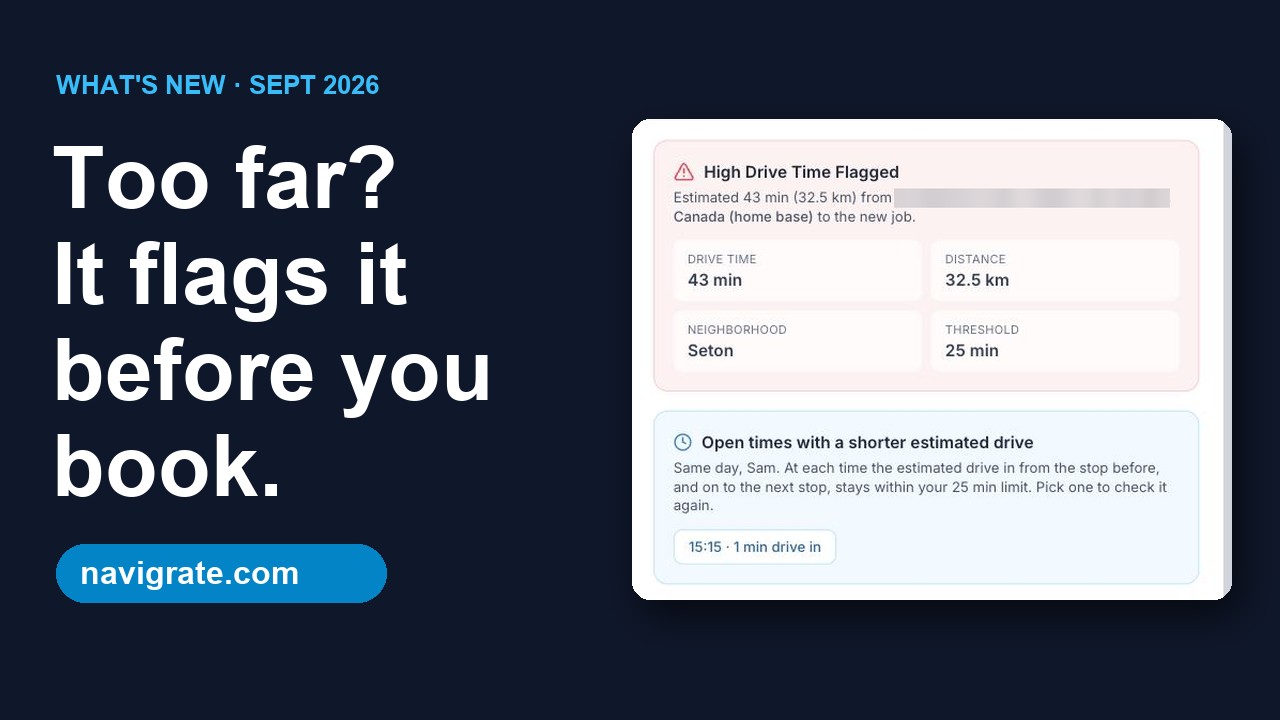
One way to bring it down is to check the drive before you commit to a time. How to cut drive time between jobs has seven ways to do that, with or without software. Still on a whiteboard? Whiteboard vs dispatch board covers when that's fine and when it isn't.
See Navigrate in 90 seconds
Every screen is from the real app and website: the long-drive flag, shorter-drive open times, 12-hour bookings and pricing.
Common questions
Is this how much Navigrate would save me?
What hourly value should I use?
How do I know how many bookings had a longer drive than needed?
What happens to the numbers I type?
Can I share my result?
Try the drive check on next week's jobs
14 days free, every feature, up to 3 technicians. No card needed.
Start your free trial → 3 technicians = $29/mo · every feature on every plan